Description
Integrate language-model services into modern C++ applications by working with requests, responses and data structures directly. The course develops five projects using HTTP/HTTPS communication and JSON handling with nlohmann-json. Examples connect to hosted GPT services and local models through Ollama, then extend into embeddings, similarity search and a retrieval-augmented generation pipeline.
The application architecture evolves from a single procedural implementation into functions and then an object-oriented design. Builder-style construction, method chaining, dependency injection and composition illustrate how to separate responsibilities and support different AI backends. Request construction, structured response parsing and error handling remain visible throughout, helping learners understand the integration work that a higher-level wrapper would otherwise conceal.
Intended audience: Intermediate C++ developers adding AI features to applications. Programmers interested in direct API integration, retrieval systems and application architecture.
What you will learn
- Construct HTTP/HTTPS requests and parse JSON responses in C++.
- Connect application code to hosted AI APIs and local Ollama models.
- Implement embeddings, similarity search and a C++ retrieval pipeline.
- Refactor an application using classes, composition, dependency injection and a Builder pattern.
- Design an integration that can switch between AI backends.
Course specifications
- Publisher
- Udemy
- Instructors
- Tim Buchalka’s Learn Programming Academy, Wyzdom AI Inc, Dr. Frank Mitropoulos
- Language
- English
- Level
- Intermediate
- Duration
- 12 hours and 29 minutes
- Subtitle
- Not Available
- Quality
- 1080p
- Edition
- 2026-8
Course topics
View course topics
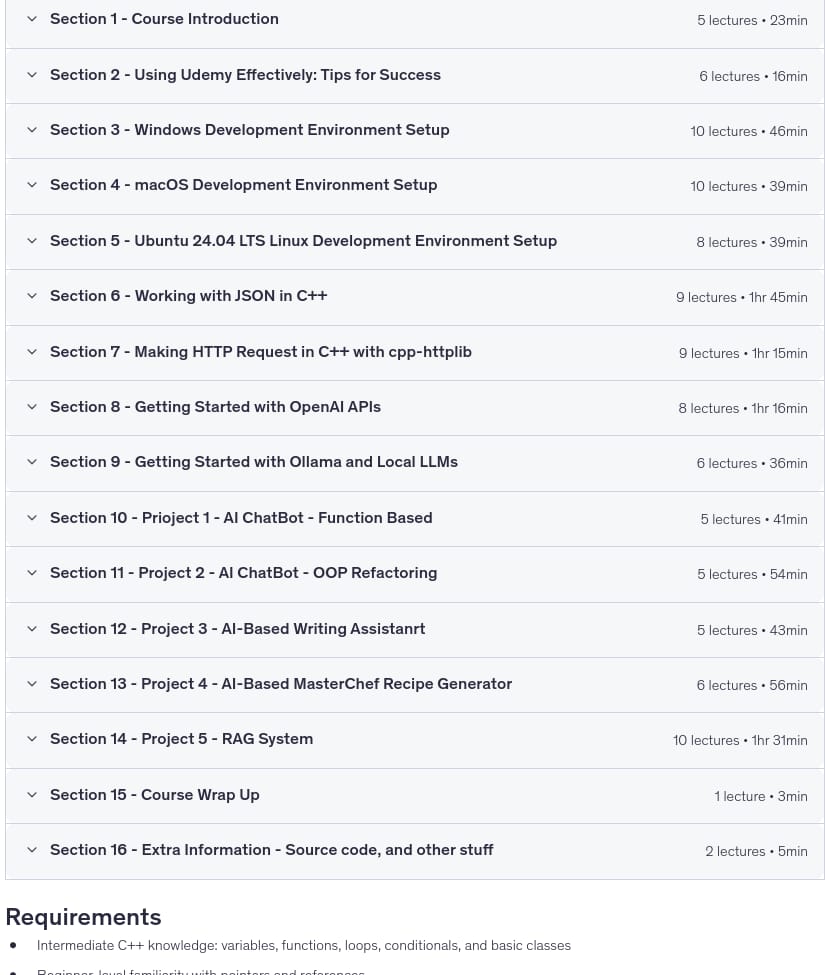
The course topics image is temporarily unavailable.
Prerequisites
- Intermediate C++, including functions, control flow and basic classes, plus introductory pointers and references.
- Comfort using a terminal, installing software and working in an IDE.
- A computer capable of running CLion and Docker Desktop; the source lists 8 GB RAM minimum, 16 GB recommended and 15–20 GB of available storage.
- The listed environments are Windows 10/11, recent macOS or Ubuntu 24.04 LTS.
- No prior Python, AI or machine-learning study is required; a GPU is not listed as necessary.
Pictures
This picture is temporarily unavailable.
Introduction video
How to open the files
Keep all parts of the same edition together before extracting the first archive. Open the included course media with a compatible player.
Download resources
Choose one edition and keep its parts together. Alternate providers are available when listed.
2026-8 · 1080p
Direct downloads
2026-8 · 1080p
Size
7.25 GB
Leave a Reply
Signed-in member comments appear immediately.